How Caring for Other Life Keeps Us Alive

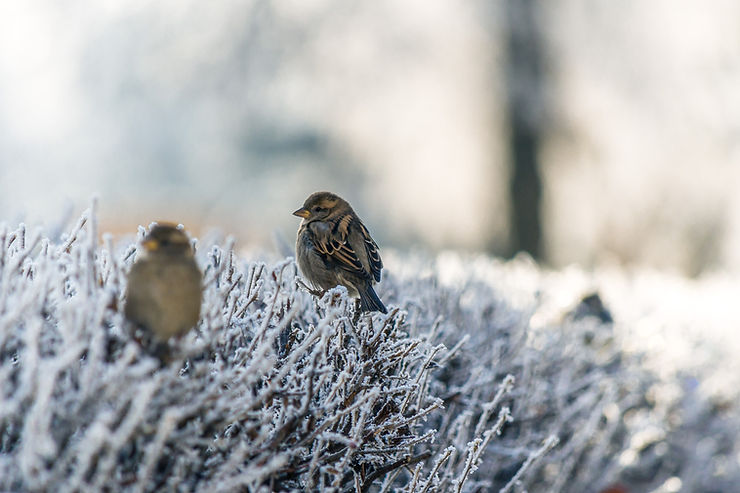
Recently, on a frigid and snowy winter morning, I found myself standing at my kitchen window, hot cacao drink in hand, watching a small gathering of birds flit about the trees and bird-feeders in my backyard. Robins hopped along the frozen ground. Bright red cardinals flashed through the bare branches. Mourning doves pecked for food that had fallen on the snow. Sparrows and wrens darted in and out of the shrubs, clearly aware that winter is not a forgiving season. The birdbath, however, was frozen solid, and the birdfeeders were empty.
Something about how those birds were struggling for their survival touched my heart. So, I pulled on a coat, dumped out the ice and snow, and poured hot water into the birdbath basin until steam rose from it into the frosty air. Then, I refilled the birdfeeders. Within minutes, it became a scene of joyful chaos—a true bird party. Birds splashed, drank, fluttered in and out, puffed up their feathers, and took turns at the feeder. Watching them, I felt an unexpected warmth spread through me, a deep sense of satisfaction that had nothing to do with productivity or achievement. It struck me that this simple act, providing warm water and food for desperately cold and hungry birds in my neighborhood was quietly profound.
At its core, life is not a solitary pursuit. Life is collaborative. Every one of us is the product of two parents, who themselves came from two parents, in an unbroken chain stretching all the way back to the origins of life. Every ancestor in that long lineage survived long enough to reproduce and successfully contribute to the survival of the next generation. None of us are here by accident, and none of us are here alone, and it is truly a miracle that you made it into existence considering the long odds of each of your unimaginably large number of ancestors surviving and reproducing.
From a biological perspective, evolution isn’t really about the survival of the strongest or even the smartest individual. It is about survival of the most adaptable and cooperative. As Richard Dawkins so elegantly explained in The Selfish Gene, evolution favors the survival of genes. Genes persist when they help organisms cooperate, nurture, protect, and contribute to the success of the group—especially family and community.
Seen through that lens, it makes sense that humans evolved to thrive through relationships. We are wired for connection, empathy, and contribution. In fact, we even carry genes that can work against us when we become disconnected or no longer useful to the web of life around us. Chronic isolation, purposelessness, and disconnection don’t just feel bad emotionally—they accelerate biological decline. Loneliness, after all, is as toxic to health as smoking or obesity.
But the inverse is also true. When we invest in the well-being of life around us—our children, our partners, our friends, our neighbors, our communities, our pets, our gardens, even the birds in our backyard—we activate something deeply ancient and protective within ourselves. We reinforce our place in the living network. We signal, at a cellular level, that we still matter, that we still contribute, that we are part of something larger than ourselves.
There’s an old saying that the quality of your life is directly proportional to the quality of your relationships. I believe that’s not just poetic wisdom, it’s biological truth. Health and longevity are not merely the result of good genes, exercise, or diet. They are powerfully shaped by the richness of our relationships and the degree to which we are woven into a mutually supportive tapestry of life.
Maybe that’s why feeding the birds felt so meaningful to me. It wasn’t about heroism or charity. It was about participation. About showing up for the life around me in a small but tangible way. And in doing so, I felt more alive and more connected.
Perhaps that’s the real meaning of life—not endless striving or self-optimization, but contributing to the flourishing of other life wherever we can. When we do that, life doesn’t just continue around us. It continues through us.
So maybe the secret to a long, meaningful life isn’t found in fame or money or accumulating more stuff, but in caring more. In noticing the frozen birdbath. In showing up for a friend. In tending a garden, nurturing a relationship, walking the dog, contributing to a community. When we foster and support the life around us, we affirm our place in the astonishing, improbable wonder that is life on this resilient, vibrant oasis of a planet we call Earth in our little corner of the vast Universe.



Comments