Fiber: The Humble Nutrient That Protects Your Heart and Gut


Decades ago, British surgeon Denis Burkitt noticed something striking. Populations that ate traditional, high-fiber diets passed large daily stools and had remarkably low rates of heart disease, diabetes, gastrointestinal (GI) diseases like esophogeal reflux, and colon cancer. As societies modernized, fiber intake and stool size shrank, while heart disease, obesity, diabetes, dementia, and the need for hospitals exploded.
Burkitt famously quipped, “If you pass small stools, you need large hospitals.”
Scientific data strongly support the spirit of his observation: Low fiber intake tracks closely with higher burdens of chronic disease and health care use.
I believe that markedly increasing daily fiber intake is one of the simplest and most powerful habits for improving long-term health—for your heart, your gut, and likely your longevity.
An Avocado a Day Keeps the Doctor Away
My grandson Grant jokes, “An apple a day keeps the doctor away. . . if you throw it hard enough.” My version is simpler: An avocado a day keeps the doctor away.
One large avocado delivers 13 to 14 grams (g) of fiber—nearly half the daily need. I eat at least one daily, along with nuts, seeds, berries, legumes, and plenty of non-starchy vegetables like leafy greens, broccoli, and tomatoes. Avocados are calorie-dense, but they’re filling and nutrient-rich—and they crowd out junk food.
Instead of guacamole with chips, I eat it with celery and carrot sticks. I also aim for at least one serving of legumes—beans, lentils, or edamame—daily.
Each morning, I mix about 2 tablespoons of psyllium fiber into a large glass of water and drink it quickly. I also take a capsule of beta-glucan, the soluble fiber found in oats and barley. I’ve done this for years because it reliably supports gut comfort, cholesterol levels, and overall wellbeing.
Why Fiber Is Fundamental
Fiber is the part of plant foods your digestive enzymes can’t break down. It survives the stomach and small intestine and arrives in the colon, where it feeds beneficial microbes and adds bulk that keeps things moving.
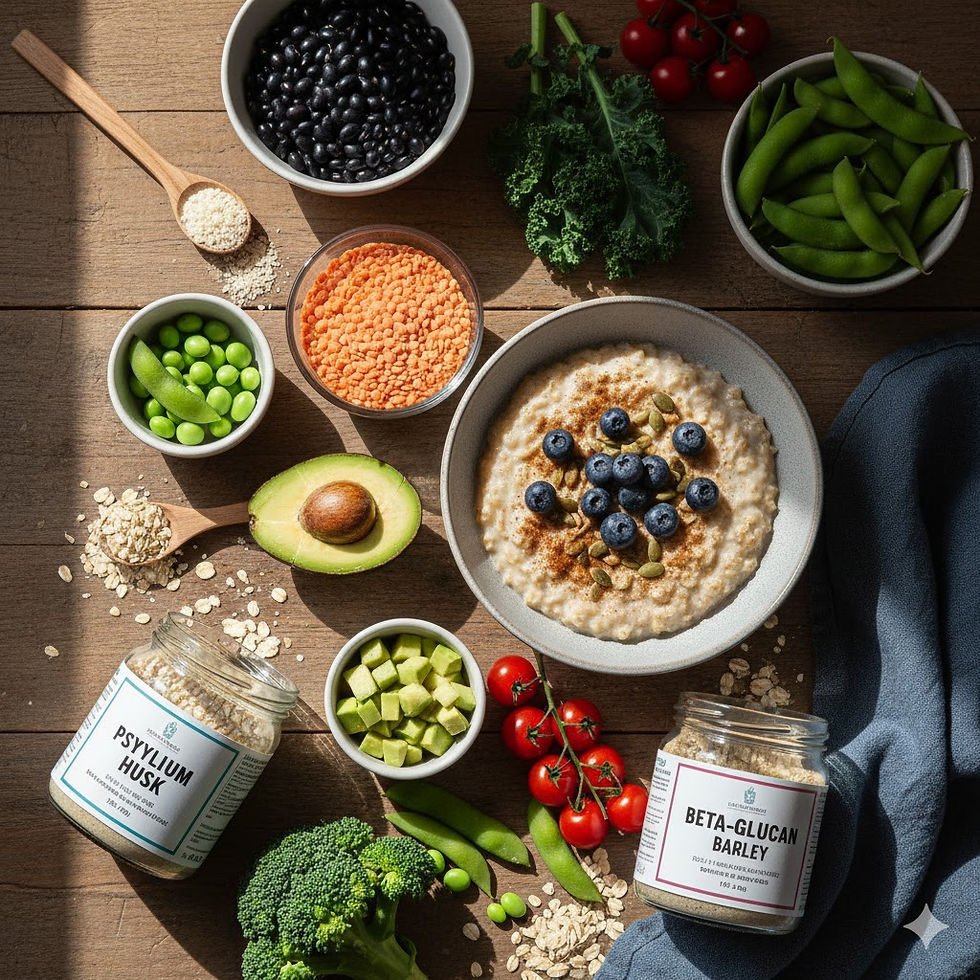
Different fibers play different roles:
Insoluble fiber (vegetable skins, nuts, seeds, wheat bran): adds bulk and speeds transit
Soluble viscous fiber (psyllium, oat and barley beta-glucan): forms a gel that slows digestion, blunts blood sugar spikes, and lowers LDL cholesterol
Fermentable fiber & resistant starch (beans, lentils, oats, onions, green bananas): feed gut microbes, producing short-chain fatty acids like butyrate that protect the colon
Think of insoluble fiber as the broom, viscous fiber as the sponge, and fermentable fiber as fertilizer for your gut garden.
Fiber, Cholesterol, and the Heart
Large population studies consistently show that people who eat the most fiber have 20–30% lower rates of cardiovascular disease and premature death than those who eat the least. While observational, the findings are remarkably consistent—and biologically plausible.
The strongest heart benefits come from viscous soluble fibers:
Psyllium binds bile acids in the gut. Because bile acids are made from cholesterol, the liver pulls more LDL (“bad”) cholesterol from the blood to replace them. About 10 g per day lowers LDL cholesterol by about 10–12 milligrams per deciliter (mg/dL) in clinical trials.
Beta-glucan from oats and barley works similarly. About 3 g per day—easily reached with a hearty bowl of oatmeal—can reduce LDL cholesterol by roughly 10 mg/dL.
These effects are modest compared with cholesterol-lowering medications like statins or PCSK9 inhibitors, but they are safe, consistent, additive, and FDA-approved for heart-health claims. Fiber won’t replace your medications—but they’re a steady tailwind in the right direction.
Blood Sugar, Weight, and Metabolic Health
Viscous fibers slow gastric emptying and carbohydrate absorption, flattening post-meal glucose and insulin spikes. In randomized trials, they lower HbA1c levels—a measure of average blood sugar over three months—by 0.4–0.6%, which can make the difference between developing diabetes or avoiding it.
For weight, fiber helps, but it’s not magic. By increasing fullness, it often leads to 100 to 200 fewer calories per day, resulting in two to five pounds of weight loss over several months.
In the era of powerful antidiabetic GLP-1 medications like semaglutide and tirzepatide, fiber is a supportive ally, not a substitute. Importantly, extra fiber helps prevent constipation in people taking GLP-1 medications like Zepbound® and Wegovy®.
Your Gut, Your Microbiome, and Colon Cancer Risk
In the colon, fermentable fibers feed gut bacteria, which produce butyrate, the preferred fuel for colon-lining cells. Butyrate strengthens the gut barrier, reduces inflammation, and may help damaged cells self-destruct before becoming cancerous.
Higher fiber intake is associated with lower colorectal cancer risk, with studies suggesting about an 8% risk reduction per additional 8 g of fiber per day, up to 40 g. Not absolute proof, but with minimal downside, it’s a wager I gladly take.
On a practical level, fiber keeps you regular. Insoluble fibers add bulk; psyllium normalizes stool consistency, helping both constipation and diarrhea. When patients say, “My gut feels better when I get my fiber,” the science agrees.
A Few Practical Tips:
Go slow. Increase fiber by about 5 g per day every week or two.
Hydrate well. Psyllium absorbs water—take it with a large glass.
Mind medications. Take fiber supplements a couple of hours before or after drugs with narrow dosing windows.
So What Should You Do?
Here’s what I now recommend for most patients, family, friends—and myself:
Aim for 30–40 g of fiber daily (at least 25 g).
Get most of it from real food: vegetables, legumes, oats, barley, fruits (especially avocados and berries), nuts, and seeds.
Eat unsweetened yogurt and/or take a probiotic supplement. This helps to establish and maintain a healthy microbiome—the community of 40 trillion microbes in your gut that is essential for strong immunity and a healthy GI system.
Use supplements to fill gaps:
Psyllium husk: start with 1 teaspoon daily and work up to 1 or 2 tablespoons per day, ideally with your largest carb-containing meal.
Beta-glucan: from oats, oat bran, barley, or a supplement, 1 to 3 g per day.
Bottom Line
Most people would be wise to make fiber—especially psyllium and beta-glucan—a daily habit. It’s simple, safe, inexpensive, and powerfully supportive of heart health, gut health, and a longer, more energetic life.


Comments